Beethoven, Liszt, Mozart and Snow
Yesterday it snowed in Paris. Although not as much as in Cornwall.
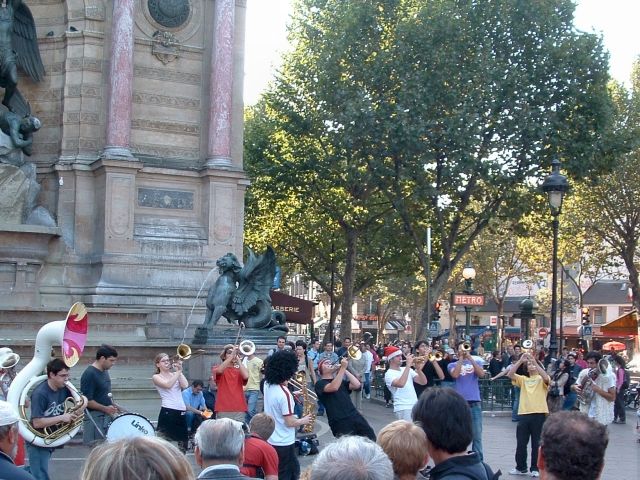
On an subject related only as tenuously as the title of this post, the Ensemble Orchestral et Choral diaphonie were also playing in the Basilic Sainte Clotilde, over in the 7th. A little more professional than the pictured group, who we happened upon in the street a little while ago. Although judging by the information gleamed from the glossy programme, diaphonie also contained musicians from Télécom, which would probabaly explain why Sam and I found ourselves there.
The seating arrangement in the enormous church was a little daunting at first: the entire nave had been reversed. We therefore found oursleves sitting with our backs to the altar, looking at a well-lit stage under the expansive organ at the back of church.
But the strangest thing of all - it was not cold. Indeed it was bordering on warm, and we only realised in the interval that the building employed a forced hot-air heating system. An expensive, modern system, for which Sam felt obliged to leave a euro in the collection box at the door. I just paid my 10 € ticket price, and hoped the orchestra would give a donation to the church.
The programme was Beethoven’s Coriolan Overture, followed by his Romance in F - the famous one, apparently, but I didn’t know it. My favourite of the evening was Liszt’s Symphonic Poem no. 3. The most played of his 12 poems, it was presnted in all it’s cymbal-crashing glory.
Mozart never completed his Requiem, and several people have had a bash at doing that for him since his death. The one we heard was the Richard Maunder version - this exlcudes the Sanctus and Benedictus, for which Mozart didn’t leave so much as an outline. The 100-strong choir seemed to have a very high avergae age, but the mass was sung very well - at times, in fact, the intonation was better than that of the orchestra.
In all it was very well received, and definitely worth the small entry charge - although, of course, I spent my student discount on a programme. Mozart’s Requiem made a refreshing change from Brahms’ even more morose German Requiem, which I’m currently rehearsing in the orchestra at college. Whether or not I will eventually hold it in such high regard as his Mass in C Minor will remain to be seen.
